Source: Published information from Cairo University activities and media reports regarding the accreditation of the Molecular Disease Diagnostics Unit by the Egyptian Accreditation Council (EGAC).
As part of its continued efforts to strengthen quality infrastructure, scientific excellence, and internationally recognized conformity assessment activities within Egyptian academic and research institutions, the Egyptian Accreditation Council (EGAC) highlights the accreditation achievement of the Molecular Disease Diagnostics Unit at the Faculty of Veterinary Medicine, Cairo University.
The accreditation was celebrated during an official visit by Prof. Mohamed Sami Abdelsadek, President of Cairo University, to the Faculty of Veterinary Medicine, where he participated in the faculty’s celebration marking the successful accreditation of the Molecular Disease Diagnostics Unit within the Department of Clinical Pathology by the Egyptian Accreditation Council (EGAC).
The event was attended by Prof. Ahmed Samir, Dean of the Faculty of Veterinary Medicine; faculty vice deans; a number of current and former academic leaders; Prof. Mona Mahrez, former Deputy Minister of Agriculture; Prof. Magdy Hassan, President of the Egyptian Veterinary Syndicate; Prof. Ahmed El-Sabbagh, Director of the Projects Administration at the Ministry of Higher Education; distinguished faculty members; graduates holding leadership positions in academia and industry; and representatives of the veterinary sector.
Supporting Food Security and Public Health
During the event, the President of Cairo University emphasized the strategic role of the Faculty of Veterinary Medicine as one of Egypt’s leading academic institutions contributing significantly to food security, public health protection, and the preservation of animal resources.
He praised the faculty’s highly qualified academic and research staff as well as its advanced laboratories and scientific infrastructure, which contribute to preparing graduates according to internationally recognized standards and support the university’s broader mission of academic excellence and innovation.
Prof. Abdelsadek further noted that the Faculty of Veterinary Medicine plays an important role in enhancing Cairo University’s standing in international rankings through its research output, scientific achievements, and commitment to quality assurance. He reaffirmed the university’s commitment to expanding its international academic programs and supporting the faculty in obtaining additional international accreditations for its laboratories and specialized research facilities.
Research and Innovation for Sustainable Development
The President of Cairo University also reviewed the university’s ongoing efforts to maximize the impact of scientific research in support of sustainable development objectives. These efforts include the launch of AI-supported expert-house systems and the establishment of a dedicated company for managing and commercializing intellectual assets generated through university research activities.
Such initiatives aim to transform research outcomes into practical and productive projects capable of contributing to national development priorities while strengthening links between academia, industry, and society.
Accreditation Reflects Laboratory Excellence
For his part, Prof. Ahmed Samir, Dean of the Faculty of Veterinary Medicine, highlighted the faculty’s commitment to continuously upgrading its educational and training programs and aligning them with labor market requirements and emerging scientific developments.
He stated that the accreditation of the Molecular Disease Diagnostics Unit by EGAC represents a significant milestone that reflects the high level of competence, quality, and technical capability achieved by the faculty’s laboratories. He emphasized that the accreditation demonstrates compliance with internationally recognized quality requirements and reinforces confidence in the reliability of the laboratory’s testing and diagnostic activities.
Meanwhile, Prof. Ahmed El-Sabbagh noted that Cairo University continues to be one of Egypt’s leading institutions in competitively funded projects supported by the Ministry of Higher Education, with numerous accredited projects across medical, scientific, and research faculties and institutes.
Importance of Advanced Disease Diagnosis
During the celebration, Prof. Magdy Hassan, President of the Egyptian Veterinary Syndicate, emphasized the critical importance of rapid and accurate disease diagnosis in mitigating risks, reducing economic losses, and supporting effective disease control measures.
He also stressed the importance of strengthening cooperation between research institutions and production sectors while increasing the use of advanced technologies, including artificial intelligence applications, in disease surveillance, diagnostics, and epidemic management.
Opening of the Molecular Disease Diagnostics Unit
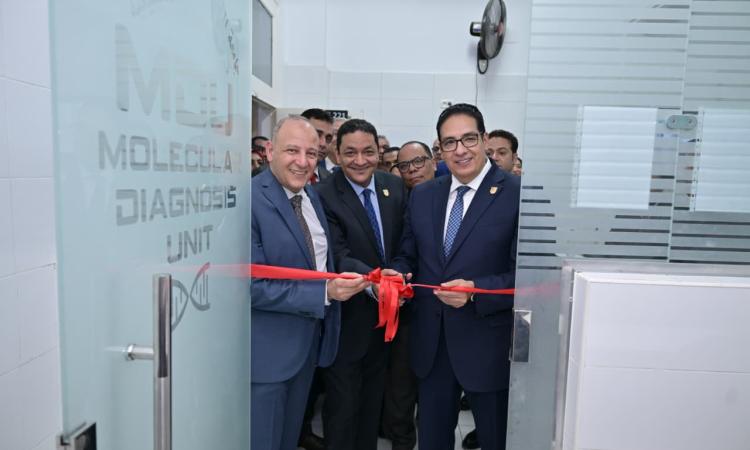
On the sidelines of the visit, the President of Cairo University officially inaugurated the Molecular Disease Diagnostics Unit, which was established through funding amounting to approximately EGP 2.4 million provided through the Projects Unit of the Ministry of Higher Education.
The unit was established to provide a modern educational and research environment that operates according to internationally recognized standards and supports advanced scientific activities in veterinary diagnostics and disease monitoring.
The facility is equipped with state-of-the-art diagnostic technologies and advanced analytical instruments designed to support rapid disease detection, precise measurements, and the diagnosis of a wide range of infectious and epidemic diseases, including avian influenza, salmonellosis, brucellosis, and lumpy skin disease.
The unit is expected to play a significant role in strengthening veterinary diagnostic capabilities, supporting scientific research, and contributing to national efforts aimed at protecting animal health and enhancing food security.
Future Expansion and Proficiency Testing Activities
Looking ahead, the Molecular Disease Diagnostics Unit plans to expand the scope of testing services it provides and further strengthen its technical capabilities.
Among its future objectives is the development of specialized proficiency testing programs, enabling the unit to become a provider of proficiency testing services for laboratories both within Egypt and internationally. Such initiatives would contribute to strengthening laboratory competence, improving the quality of testing services, and supporting broader quality infrastructure objectives.
Advanced Educational Facilities
During his visit, the President of Cairo University also toured the Faculty Library, reviewing its scientific references, research resources, and educational services available to students and researchers.
He additionally visited the faculty’s advanced Objective Structured Clinical Examination (OSCE) Virtual Laboratory, which provides students with an innovative learning environment for disease diagnosis training and veterinary surgical simulation through advanced virtual technologies. The facility contributes to enhancing practical competencies, clinical skills, and research capabilities among veterinary students while supporting modern educational methodologies.
The accreditation of the Molecular Disease Diagnostics Unit by EGAC represents another important step in strengthening confidence in the competence of Egyptian university laboratories and reflects the growing role of accredited scientific institutions in supporting research excellence, public health, food security, and sustainable development. Through internationally recognized accreditation, laboratories can demonstrate technical competence, improve the reliability of their services, and contribute more effectively to national and international scientific cooperation.